
We wanted to understand one simple thing:
what is the real evidence for body-based stress reduction?
First, is there any? Second, is it any good? And third, what does it actually say when you look closely?
What we found is encouraging: yes, there is evidence — in some areas stronger than others. Tai Chi/Qigong, for example, has consistently strong effects across many populations, while other practices (like humming or chanting) have weaker evidence but still promising beginnings. We also discovered something important: the research often separates outcomes into “stress” and “anxiety,” and these are not the same thing. So we pulled these two things apart.
What is Stress vs. Anxiety?
Stress is primarily physiological — changes in heart rate, breathing, cortisol, tension, and energy. Stress is your body responding to a demand.
Anxiety, on the other hand, is primarily emotional and cognitive — worry, fear, anticipation, looping thoughts, and feeling unsafe. Anxiety is your mind interpreting the world as a threat.
You can have stress without anxiety (a deadline, a cold plunge, an intense workout).
You can have anxiety without stress (ruminating at night in a quiet room).
And many times, the two overlap.
How to read the table
The table below shows the effect size for each modality on stress and anxiety separately, along with the strength of the evidence supporting it. If you want to dig deeper, every row is tied to footnotes with the exact meta-analyses and reviews we used.
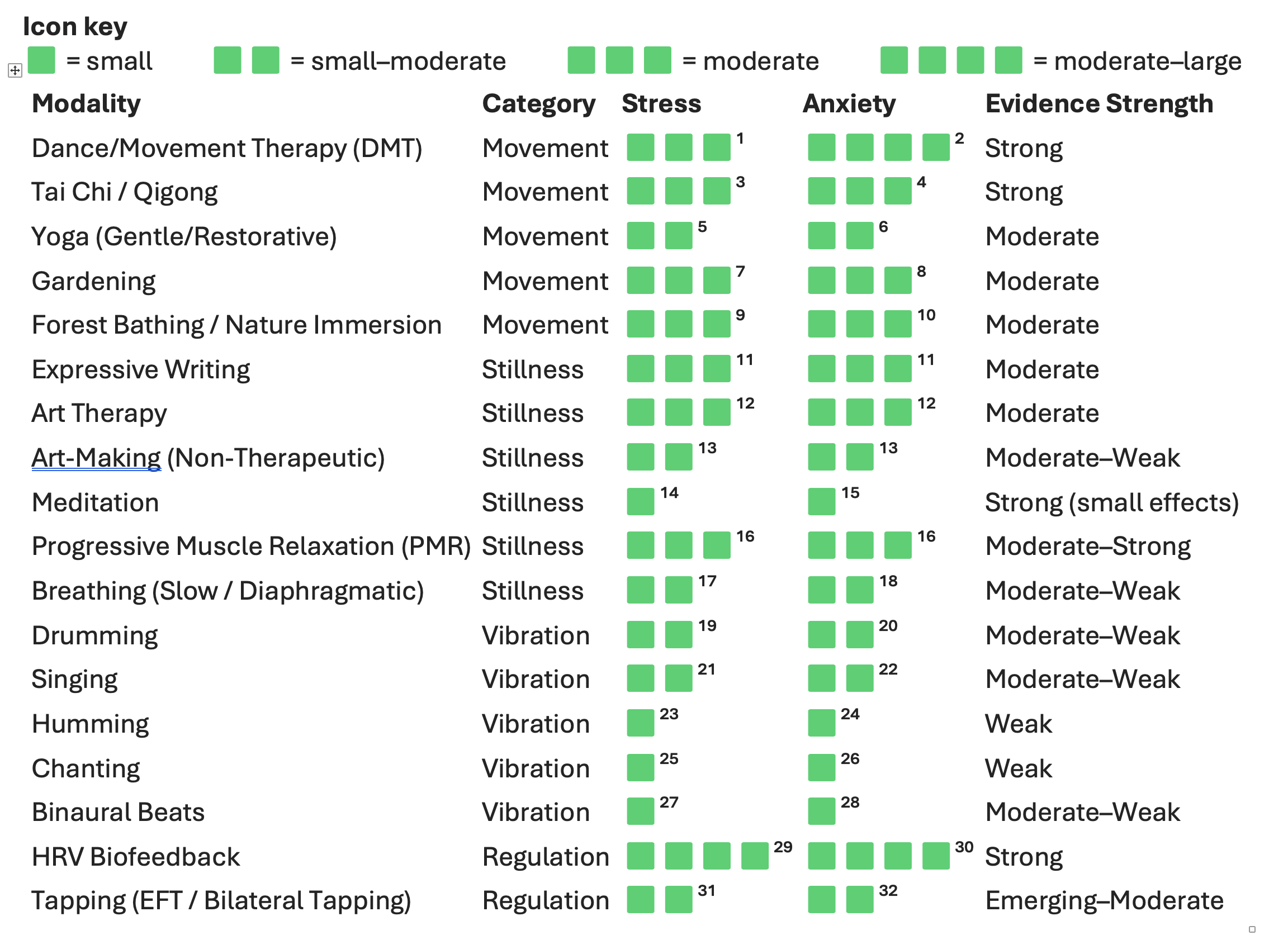
movement based modalities
Dance/Movement Therapy (DMT)
A clinical, therapist-led modality using movement for emotional processing. Not the same as recreational dance.
1. Stress — Lee et al., 2015 (Meta-analysis, 23 studies)
Moderate reductions in stress and psychological distress.
2. Anxiety — Koch et al., 2019 (Meta-analysis, 41 studies)
Moderate–large reductions in anxiety.
Note:
“Dance” in this chart refers to Dance/Movement Therapy (DMT) — a structured therapeutic approach. Recreational dance has benefits but lacks equivalent research for stress/anxiety.
Yoga (Gentle / Restorative)
Slow-paced yoga focusing on breath, stretching, grounding, and relaxation.
5. Stress — Cramer et al., 2018 (Systematic Review, 12 RCTs)
Small–moderate reductions; evidence quality low.
6. Anxiety — Brinsley et al., 2020 (Meta-analysis, 27 RCTs)
Small–moderate reductions in anxiety.
Note:
Evidence refers to gentle, breath-focused yoga — not vigorous, athletic, or hot yoga forms.
Forest Bathing / Nature Immersion
Slow sensory-based immersion in natural environments.
9. Stress — Antonelli et al., 2019 (Meta-analysis, 28 studies)
Moderate improvements in stress physiology (cortisol, HRV).
10. Anxiety — Kotera et al., 2020 (Review)
Moderate reductions in anxiety and rumination.
Tai Chi / Qigong (TCQ)
Slow movement sequences with regulated breathing and mindful attention.
3. Stress — Liu et al., 2019 (Meta-analysis, 12 studies)
Moderate reductions in perceived stress.
4. Anxiety — Wang et al., 2014 (Meta-analysis, 37 RCTs)
Moderate reductions in anxiety.
Note:
High-quality reviews combine Tai Chi + Qigong, as studies rarely separate them and mechanisms are nearly identical.
Gardening / Horticultural Therapy
Tending plants and soil; combines nature exposure, sensory grounding, and light movement.
7. Stress — Soga et al., 2017 (Systematic Review, 22 studies)
Moderate reductions in stress and negative affect.
8. Anxiety — Ohly et al., 2016 (Review, 40 studies)
Moderate reductions in anxiety.
stillness based modalities
Expressive Writing
Timed emotional writing that supports processing and reorganizing stressful experiences.
11. Stress & Anxiety — Frattaroli, 2006 (Meta-analysis, 146 studies)
Moderate reductions in stress and anxiety.
Art-Making (Non-Therapeutic)
Independent creative activities (painting, drawing, crafting).
Not clinician-led.
13. Stress & Anxiety — Kaimal et al., 2016 (Review)
Small–moderate reductions in stress and anxiety.
Note:
Art-making ≠ Art Therapy.
This refers to personal creative expression, not clinical therapeutic work.
Progressive Muscle Relaxation (PMR)
Tensing and releasing muscle groups to reduce physical tension and calm the nervous system.
16. Stress & Anxiety — Conrad & Roth, 2007 (Review)
Moderate reductions in stress and somatic anxiety.
Art Therapy
A clinician-led therapeutic process integrating art-making with emotional support and reflection.
12. Stress & Anxiety — Slayton et al., 2010 (Review, 35 studies)
Small–moderate to moderate reductions in distress and anxiety.
Meditation (Mindfulness-Based)
Focused attention or open monitoring practices. Large evidence base, but small emotional effects.
14. Stress — Khoury et al., 2013 (Meta-analysis, 209 studies)
Small reductions in perceived stress.
15. Anxiety — Goyal et al., 2014 (Meta-analysis, 47 RCTs)
Small anxiety improvements.
Note:
Although meditation has a large overall evidence base, stress/anxiety-specific effect sizes are small.
Breathing (Slow / Diaphragmatic)
Breathing at a slow, steady rhythm (≈6 breaths/min).
Strong physiological effects; modest psychological evidence.
17. Stress — Zaccaro et al., 2018 (Review)
Moderate physiological effects; small–moderate psychological effects.
18. Anxiety — Hopper et al., 2019 (Meta-analysis)
Small–moderate anxiety reductions.
Note:
Breathing produces strong physiological changes (HRV↑, sympathetic↓), but psychological outcome studies are often short/underpowered.
vibration based modalities
Drumming
Group rhythmic percussion that synchronizes breath, supports emotional release, and builds social cohesion.
19. Stress — Fancourt et al., 2016 (Review)
Small–moderate stress reduction.
20. Anxiety — Fancourt et al., 2016 (Review)
Small–moderate anxiety reduction.
Note:
Drumming is one of the few vibration modalities with measured biological changes (cortisol and immune markers).
Humming
Gentle vocal resonance that boosts nitric oxide and stimulates vagal pathways. Strong physiology; limited psychological trials.
23. Stress — Lundberg et al., 2006; Jerath et al., 2015
Strong physiological rationale, few outcome trials.
24. Anxiety — Porges & Kolacz (Mechanistic)
Mechanistic support, weak outcome evidence.
Note:
Humming has powerful physiological effects but very limited research measuring stress/anxiety outcomes.
Binaural Beats
Two slightly different tones played separately to each ear create a perceived “beat” that shifts brainwave patterns.
27. Stress — García-Argibay et al., 2019 (Meta-analysis)
Small reductions in stress.
28. Anxiety — Small RCTs
Small reductions in anxiety.
Note:
Some broader reviews (mixing cognitive/perceptual outcomes) report medium effects, but stress/anxiety-specific effects remain small, which is why the modality is scored 🟩.
Singing
Breath + resonance + emotional expression; strongest evidence is for group/choir singing.
21. Stress — Gick, 2011 (Systematic Review)
Small–moderate reductions in stress.
22. Anxiety — Gick, 2011 (Systematic Review)
Small–moderate reductions in anxiety.
Note:
Singing benefits are strongest in choir/group settings where breathing and rhythm synchrony enhance vagal activation.
Chanting (Mantra, OM, Tonal Chant)
Low-frequency vocal resonance that increases HRV and slows breathing.
25. Stress — Kalyani et al., 2011
Small reductions in stress.
26. Anxiety — Pilot studies
Small anxiety reductions.
Note:
Chanting’s mechanism (resonance + vagal activation) is strong, but psychological trials are small.
regulation based modalities
HRV Biofeedback
Training heart–breath synchrony at a person’s resonance frequency (≈6 breaths/min) using sensors or apps.
One of the strongest autonomic-regulation tools.
29. Stress — Goessl et al., 2017 (Meta-analysis, 24 studies)
Moderate–large reductions in stress.
30. Anxiety — Goessl et al., 2017; Lehrer et al., 2020
Moderate–large reductions in anxiety.
Note:
HRV Biofeedback produces some of the largest and most consistent physiological and clinical effects across all modalities.
Tapping (EFT / Bilateral Tapping)
Light tapping on acupressure points or alternating bilateral tapping paired with emotional focus.
31. Stress — Church et al., 2018 (Review); Nelms & Castel, 2016 (Meta-analysis)
Small–moderate stress reductions.
32. Anxiety — Clond, 2016 (Meta-analysis); Church et al., 2018 (Review)
Small–moderate to moderate reductions.
Note:
EFT results are promising, but the research base is less independently replicated than other modalities. Evidence is emerging–moderate.
Footnotes
1. DMT — Stress
Lee et al., 2015 (meta-analysis, 23 studies): DMT produced moderate reductions in stress and psychological distress.
2. DMT — Anxiety
Koch et al., 2019 (meta-analysis, 41 studies): moderate–large reductions in anxiety, among the strongest mind–body effects.
3. Tai Chi/Qigong — Stress
Liu et al., 2019 (meta-analysis, 12 studies): moderate reductions in perceived stress.
4. Tai Chi/Qigong — Anxiety
Wang et al., 2014 (meta-analysis, 37 RCTs): moderate reductions in anxiety versus controls.
5. Yoga — Stress
Cramer et al., 2018 (systematic review, 12 RCTs): small–moderate reductions in perceived stress; evidence quality low.
6. Yoga — Anxiety
Brinsley et al., 2020 (meta-analysis, 27 RCTs): small–moderate improvements in anxiety.
7. Gardening — Stress
Soga et al., 2017 (systematic review, 22 studies): moderate reductions in stress and negative mood.
8. Gardening — Anxiety
Ohly et al., 2016 (review, 40 studies): moderate reductions in anxiety and emotional distress.
9. Forest Bathing — Stress
Antonelli et al., 2019 (meta-analysis): moderate improvements in physiological stress markers (e.g., cortisol, HRV).
10. Forest Bathing — Anxiety
Kotera et al., 2020 (review): moderate reductions in anxiety and rumination.
11. Expressive Writing — Stress & Anxiety
Frattaroli, 2006 (meta-analysis, 146 studies): moderate reductions in stress and anxiety, especially with emotional writing instructions.
12. Art Therapy — Stress & Anxiety
Slayton et al., 2010 (review, 35 studies): small–moderate to moderate reductions in distress and anxiety across clinical art therapy programs.
13. Art-Making — Stress & Anxiety
Kaimal et al., 2016 (review): small–moderate reductions in stress and anxiety from non-clinical creative art-making.
14. Meditation — Stress
Khoury et al., 2013 (meta-analysis, 209 studies): small reductions in perceived stress.
15. Meditation — Anxiety
Goyal et al., 2014 (meta-analysis, 47 RCTs): small anxiety improvements compared with active controls.
16. PMR — Stress & Anxiety
Conrad & Roth, 2007 (review): moderate reductions in stress and somatic anxiety across multiple relaxation trials.
17. Breathing — Stress
Zaccaro et al., 2018 (systematic review, 48 studies): slow/diaphragmatic breathing produced small–moderate to moderate improvements in stress physiology and perceived stress.
18. Breathing — Anxiety
Hopper et al., 2019 (meta-analytic work on breathwork): small–moderate reductions in anxiety across varied populations.
19. Drumming — Stress
Fancourt et al., 2016 (review): group drumming yielded small–moderate reductions in stress and negative mood; some studies showed changes in cortisol and immune markers.
20. Drumming — Anxiety
Fancourt et al., 2016 (review): small–moderate reductions in anxiety and tension.
21. Singing — Stress
Gick, 2011 (systematic review): small–moderate reductions in stress and improvements in wellbeing, especially in choir/group singing.
22. Singing — Anxiety
Gick, 2011 (systematic review): small–moderate reductions in anxiety and emotional tension.
23. Humming — Stress
Lundberg et al., 2006; Jerath et al., 2015 (mechanistic physiology): humming substantially increases nasal nitric oxide, slows breathing, and activates vagal pathways linked to stress reduction; few direct stress trials.
24. Humming — Anxiety
Porges & Kolacz (polyvagal mechanism papers): humming engages vagal and social-engagement pathways likely to reduce anxiety, but controlled trials are limited.
25. Chanting — Stress
Kalyani et al., 2011 (small trials of OM chanting): increased HRV, slowed respiration, and small reductions in stress arousal.
26. Chanting — Anxiety
Small pilot studies on mantra/OM chanting: small decreases in anxiety and tension; evidence base remains limited.
27. Binaural Beats — Stress
García-Argibay et al., 2019 (meta-analysis, ~22 studies): binaural beats produced small reductions in perceived stress and increased relaxation, especially with alpha frequencies.
28. Binaural Beats — Anxiety
Small RCTs (e.g., pre-procedure anxiety, short-term listening): small, short-term reductions in anxiety, most consistently with theta/alpha beats.
Note: broader meta-analyses across mixed outcomes sometimes show medium overall effects, but stress/anxiety-specific effects remain small.
29. HRV Biofeedback — Stress
Goessl et al., 2017 (meta-analysis, 24 studies): HRV biofeedback produced moderate–large reductions in stress and improved autonomic regulation (HRV, vagal tone).
30. HRV Biofeedback — Anxiety
Goessl et al., 2017; Lehrer et al., 2020 (meta-analysis + narrative review): moderate–large reductions in anxiety and strong improvements in autonomic flexibility.
31. Tapping (EFT) — Stress
Church et al., 2018 (systematic review, 20 RCTs); Nelms & Castel, 2016 (meta-analysis): consistent small–moderate reductions in perceived stress and emotional distress, though methodological quality varies.
32. Tapping (EFT) — Anxiety
Clond, 2016 (meta-analysis, 14 studies); Church et al., 2018 (review): small–moderate to moderate reductions in anxiety symptoms; evidence classified as emerging–moderate due to heterogeneity and limited independent replication.